Running Pace Calculator
Knowing your training paces can make a huge difference to how effective and enjoyable your running feels.
Using a 5K or 10K time trial to find your Half or Marathon Paces
This calculator helps you translate a recent race or time trial into realistic pace ranges for different distances, so your easy runs stay easy and your hard sessions are actually hard, without falling into the one-pace-fits-all trap.
It is based on the Riegel method and designed to help you understand what your target training paces should look like right now, based on your current fitness, not an old PB or a finger-in-the-air guess.
Think of this as a starting point, not a verdict. Fitness changes, effort varies day to day. This tool is here to support your training, not dictate it.
Use it, revisit it, and let it evolve as you do.
Race Time Predictor (Riegel 1.06)
* Use lower values (1.04–1.05) if endurance is a strength, and higher values (1.07–1.10) if you are newer to longer distances.
If you’re unsure how accurate this can be, here’s a real-world example from 2025, when I ran personal bests across all four distances within the same training block.
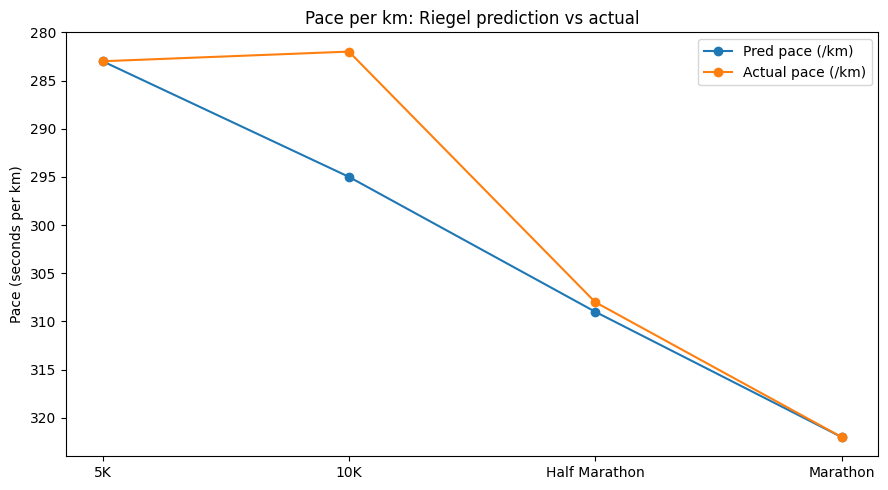
Using my 5K time as the starting point, this is how the Riegel method predicted my 10K, half marathon and marathon times compared to what I actually ran. Aside from a freakishly fast 10K, which I’m putting down to a good day and zero pressure, the longer distances lined up remarkably well.
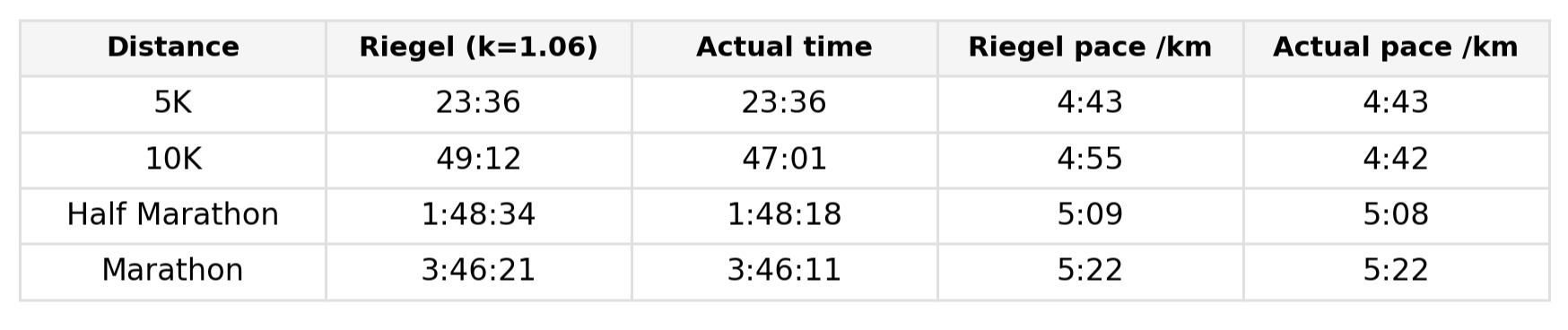
10K time @ Run Through Fulham 10K on 16th November 2025.
Half-Marathon @ The Big Half on 7th September 2025.
Marathon @ Chicago Marathon on 12th October 2025.